
Obesity and Blood Sugar Management: Treating Weight and Glucose as One Problem
A medically supervised programme for prediabetes, type 2 diabetes and weight-related metabolic disease — with defined targets and defined review points.
Medically reviewed by the Obesity & Blood Sugar team, Yiling Hospital · Reading time approx. 10 minutes

Weight and blood glucose are usually treated as two separate appointments. They are not two problems. Visceral fat drives insulin resistance, insulin resistance drives beta-cell overwork, beta-cell overwork produces type 2 diabetes, and the medication used to treat the diabetes frequently causes further weight gain. Treating either half in isolation is why so many people spend a decade oscillating between dieting and dose increases.
Effective obesity and blood sugar management means treating them together, with measured targets, a defined sequence, and a written plan for what happens at month three, six and twelve. This article sets out what that programme involves and what realistic outcomes look like.
Why the Scale Is the Wrong Measurement
Body weight is a single number that conceals three different things: fat mass, muscle mass and water. Two people can weigh the same and have radically different metabolic risk. Losing five kilograms of muscle is a worse outcome than losing five kilograms of fat, yet the scale reports both identically — which is why weight-only programmes so often produce frailty rather than health.
A clinical programme therefore measures body composition, not just weight: fat mass, skeletal muscle mass, visceral fat area and waist circumference. Visceral fat in particular is the depot most strongly associated with insulin resistance, and it responds to treatment before the scale moves at all.
Table 1 — The measurements that actually predict risk
| Measure | What it tells you | Target in a structured programme |
|---|---|---|
| HbA1c | Average blood glucose over the preceding 8–12 weeks | Below 7.0% for most people with diabetes; below 6.5% if remission is the goal |
| Fasting insulin and HOMA-IR | Degree of insulin resistance independent of glucose | Falling trend across reviews; used to detect prediabetes before HbA1c rises |
| Waist circumference | Visceral adiposity — the metabolically active depot | Below 90 cm in men and 85 cm in women (Asian thresholds) |
| Body composition (bioimpedance or DXA) | Fat mass versus skeletal muscle mass | Fat mass falling while muscle mass is preserved or increased |
| Liver fat and liver enzymes | Metabolic-associated fatty liver disease | ALT normalising; steatosis reducing on imaging |
| Blood pressure and lipids | Combined cardiovascular risk | Below 130/80 mmHg where tolerated; LDL at risk-appropriate target |
| Sleep apnoea screening | A common, treatable driver of insulin resistance | Assessed at baseline; treated if confirmed |
Assessment First: Finding What Is Actually Driving the Weight
Not all obesity has the same cause, and the treatment differs accordingly. Before any prescription, a proper assessment excludes or identifies the contributors that change the plan.
Endocrine and metabolic causes
Hypothyroidism, Cushing syndrome, polycystic ovary syndrome and hypogonadism all produce weight gain or make weight loss unusually resistant. They are uncommon but not rare, and missing them means prescribing discipline for a hormonal problem.
Medication-induced weight gain
Several common drug classes cause meaningful weight gain: some antidepressants, antipsychotics, insulin secretagogues, beta-blockers and steroids. A programme that does not review the existing prescription is working against itself.
Sleep and stress
Short sleep and untreated obstructive sleep apnoea raise ghrelin, lower leptin sensitivity and increase insulin resistance independently of diet. Patients who cannot lose weight despite adherence very often have a sleep disorder nobody asked about.
The Programme: Five Levers, One Plan
Yiling Hospital’s obesity and blood sugar management clinic runs a structured programme built on five coordinated components. It is led by an endocrinology specialist working alongside a dietitian, an exercise physiologist and a Chinese medicine physician — which is what makes it a clinical service rather than a commercial diet plan.

1. Nutrition that preserves muscle
The objective is not simply a calorie deficit — it is a deficit with adequate protein (commonly 1.2–1.6 g per kilogram of target body weight) and sufficient fibre, so that weight lost is fat rather than muscle. Plans are built around the patient’s actual cuisine and working pattern. A diet a patient cannot follow for twelve months is not a treatment plan; it is a temporary experiment.
2. Exercise that protects lean mass
Progressive resistance training is non-negotiable in a weight-loss programme, because it is the only lever that reliably preserves muscle during energy restriction. Aerobic activity is added for cardiorespiratory fitness and visceral fat, not as the primary weight-loss tool — exercise burns fewer calories than most people assume, and far more useful than its calorie cost is its effect on insulin sensitivity.
3. Pharmacotherapy, prescribed properly
GLP-1 receptor agonists and dual GIP/GLP-1 agonists have changed what medical weight management can achieve, and they are legitimately indicated for many patients with obesity and dysglycaemia. They are also frequently prescribed badly: started without baseline bloodwork, titrated too fast, continued without reviewing muscle mass, or stopped abruptly with no maintenance plan. In a supervised programme the drug is one component with a defined start, a titration schedule, monitoring for gastrointestinal effects and lean-mass loss, and a planned exit strategy.
4. Chinese medicine and acupuncture
Constitution-based herbal formulas and auricular or body acupuncture are used to support appetite regulation, sleep quality and bowel function, and to reduce the rebound hunger that follows rapid weight loss. These are adjuncts. They do not replace nutrition, exercise or indicated pharmacotherapy, and a programme that offers them as the primary intervention is not a medical programme.
5. Behavioural structure
Self-monitoring, planned meals, a defined response to a lapse, and a scheduled review calendar. The behavioural component is unglamorous and it is where most of the durability comes from.
Blood tests before a prescription. A body composition measurement at every review. A written titration schedule. A stated HbA1c target. A plan for month twelve. If a provider offers none of these, it is selling a product rather than treating a disease.
Can Type 2 Diabetes Actually Go Into Remission?
Yes — for a subset of patients, and the evidence is stronger than most people expect. The DiRECT trial, published in The Lancet, randomised patients with type 2 diabetes diagnosed within the previous six years to a structured low-energy diet programme delivered in primary care. Remission — defined as HbA1c below 6.5% with no glucose-lowering medication for at least two months — was achieved in 46% of the intervention group at twelve months, and 36% at twenty-four months. Duration of diabetes and the amount of weight lost were the strongest predictors of success.
The clinical implication is specific: remission is most achievable in patients with shorter disease duration, preserved beta-cell function and the capacity to lose a meaningful amount of weight. It is least achievable in long-standing diabetes with established complications. A responsible programme states which category a patient is in at the start, rather than implying that everyone can stop their medication.
Yiling Hospital’s clinic defines remission the same way — HbA1c below 6.5% sustained for three months without glucose-lowering drugs — and reports it as an outcome to be measured, not a promise to be advertised.
Prediabetes: The Window That Most People Miss
Prediabetes is defined by an HbA1c of 5.7–6.4%, impaired fasting glucose or impaired glucose tolerance. It is the point at which progression to type 2 diabetes is most preventable — and the point at which most health systems do nothing, because nothing is yet ‘wrong’.
Structured intervention at this stage — modest weight loss, resistance training, treatment of sleep apnoea, and where indicated pharmacotherapy — reduces progression substantially. For a patient in their forties with a family history, this is the single highest-value conversation available in a metabolic clinic.
Beyond the Scale: The Conditions That Travel With Excess Weight
Weight and glucose are the two numbers patients track, but visceral fat also drives three conditions that are frequently missed because they are silent: fatty liver, obstructive sleep apnoea and, in women, polycystic ovary syndrome. Each needs to be identified at assessment, because each independently worsens insulin resistance.
Metabolic-associated fatty liver disease
Fatty liver affects a large proportion of people with obesity and dysglycaemia and is usually asymptomatic until fibrosis has developed. Liver enzymes can be entirely normal. A programme should therefore check ALT, consider fibrosis scoring, and arrange imaging where indicated — because a 7–10% reduction in body weight measurably reduces hepatic fat, making fatty liver one of the most responsive targets available.
Obstructive sleep apnoea
Untreated apnoea fragments sleep, raises sympathetic tone and worsens glucose control and blood pressure. Patients who adhere strictly to a diet and still do not lose weight very often have this, undiagnosed. Screening with a validated questionnaire costs minutes and can change the entire trajectory of the programme.
Polycystic ovary syndrome
PCOS is driven substantially by insulin resistance, which means weight and glycaemic management are not cosmetic but therapeutic: modest weight loss can restore ovulatory cycles and improve androgen profiles. Management needs to be coordinated with gynaecology or endocrinology rather than handled as a weight problem alone.
What the Twelve Months Look Like
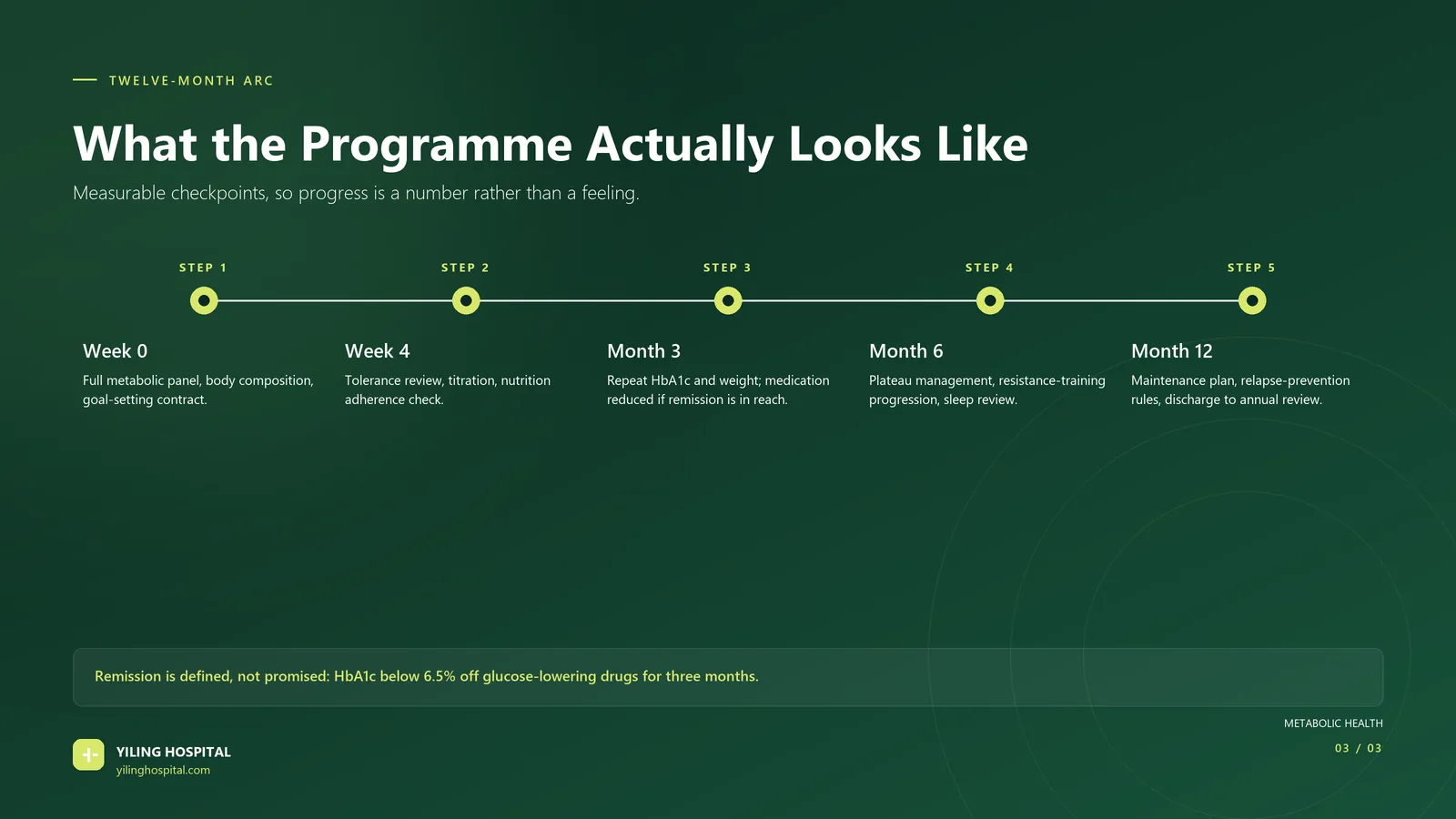
- Week 0 — full metabolic panel, body composition, blood pressure, sleep screening, medication review and a written goal contract.
- Week 4 — tolerance and adherence review, pharmacotherapy titration, early adjustment before motivation fades.
- Month 3 — repeat HbA1c, weight and body composition. If glycaemic control has normalised, medication is reduced rather than left unchanged by inertia.
- Month 6 — plateau management, progression of resistance training, review of sleep and stress, and reassessment of cardiovascular risk.
- Month 12 — maintenance plan, explicit relapse-prevention rules, and discharge to annual review for patients who have met their targets.
The Part Everyone Underestimates: Keeping It Off
Weight regain after successful loss is the normal physiological response to a reduced-energy state, not a moral failure. Metabolic adaptation, increased hunger signalling and reduced spontaneous movement persist well beyond the period of active dieting.
Programmes that succeed long-term plan for this from day one: they set a maintenance range rather than a single target weight, keep resistance training permanent, retain some form of structured monitoring, and accept that long-term pharmacotherapy is a legitimate option for a chronic condition rather than a sign of weakness.
Frequently asked questions
Major medical bodies classify obesity as a chronic, relapsing, progressive disease. Genetics, hormones, medication, sleep, the food environment and socioeconomic factors all influence body weight, and physiological defences actively resist weight loss. Personal responsibility still matters — but treating obesity as a character flaw is both inaccurate and clinically counterproductive.
Less than most people expect, and more than a crash diet delivers. A 5–7% reduction in body weight measurably improves glycaemic control, blood pressure and lipids. Sustained remission is generally associated with substantially greater loss — in the DiRECT trial, remission rates rose sharply with the magnitude of weight lost. The target is therefore set individually, with duration of diabetes taken into account.
It can often be returned to normal glucose tolerance, and progression to type 2 diabetes can be substantially delayed or prevented with structured intervention. Because HbA1c is an average, improvement is generally visible within three months of consistent change.
GLP-1 receptor agonists have a substantial evidence base and are approved for long-term use in obesity and type 2 diabetes. Common adverse effects are gastrointestinal and usually transient during titration. Important considerations include preservation of muscle mass, monitoring of pancreatic and gallbladder symptoms, and the fact that weight regain is common if the drug is stopped without a maintenance plan. They require medical supervision, not self-prescription.
No. Total carbohydrate restriction is one strategy among several, and it is difficult to sustain in most food cultures. Portion structure, protein at every meal, carbohydrate quality and meal timing usually matter more than elimination. The best plan is the one that produces the required metabolic result while remaining livable for years.
Expect 0.5–1 kg of fat loss per week in the active phase, with faster initial loss that includes glycogen and water. HbA1c changes lag by roughly three months because it reflects red-cell lifespan. Waist circumference and visceral fat often improve before the scale moves much, which is why body composition is measured rather than weight alone.
The takeaway
Obesity and blood sugar management works when it is treated as one chronic condition with measurable targets, not two appointments with vague advice. Measure body composition and HbA1c, protect muscle while losing fat, prescribe pharmacotherapy properly when it is indicated, review at fixed points, and plan for maintenance from the first visit. That is the difference between losing weight and changing a trajectory.
Book a metabolic assessment
Bring your most recent HbA1c, lipid profile, liver function tests and medication list, or ask about baseline testing on arrival.
Yiling Hospital · Obesity & Blood Sugar Management Clinic · Shijiazhuang, Hebei, China
Medical disclaimer: this article is educational and does not constitute medical advice, diagnosis or a treatment recommendation. Cited trial data describes population outcomes and does not predict individual results. Any medication, including GLP-1 receptor agonists, must be prescribed and monitored by a qualified clinician.
Department experts

Collateral-disease theory for diabetes and its complications (foot, neuropathy, heart, kidney), metabolic syndrome, hyper/hypothyroidism, thyroid nodules, menopause and diabetic vascular…