On January 10, 2020, the National Science and Technology Awards Conference was grandly held at the Great Hall of the People in Beijing. The project “Construction of Traditional Chinese Medicine Collateral Theory and Its Guidance for the Prevention and Treatment of Microvascular Disease,” led by Academician Wu Yiling of the Chinese Academy of Engineering, won the First Prize of the National Science and Technology Progress Award. It is reported that this award is the only First Prize in the life sciences field for the year and also the highest award in this field for the year.
The project “Construction of Traditional Chinese Medicine Collateral Theory and Its Guidance for the Prevention and Treatment of Microvascular Disease” was primarily completed by Hebei Yiling Pharmaceutical Research Institute, with joint contributions from Fuwai Hospital of the Chinese Academy of Medical Sciences, Jiangsu Provincial People’s Hospital, Renmin Hospital of Wuhan University, Chinese PLA General Hospital, Fudan University, Sun Yat-sen University, Hebei Medical University, Capital Medical University, and others.
Microvascular disease remains a major unresolved challenge in the international medical community.
The “China Cardiovascular Disease Report 2018,” compiled by the National Center for Cardiovascular Diseases, shows that there are currently approximately 290 million cardiovascular patients in China, with one person dying from cardiovascular disease every 10 seconds. Cardiovascular disease remains the leading cause of death. High blood pressure, high blood lipids, and high blood sugar are high-risk factors that cause vascular endothelial damage, leading to the formation of atherosclerotic plaques, which then cause myocardial ischemia and coronary heart disease angina pectoris. This gradually progresses to myocardial infarction, arrhythmia, ultimately resulting in heart failure and even death. The continuous cardiovascular event process from microvascular disease to cardiovascular and cerebrovascular disease is like a chain, with each link closely connected, hence it is called the “cardiovascular event chain.”
Facing this greatest threat to human health, Academician Wu Yiling has led his research team since 2005, relying on two National 973 Program projects (National Key Basic Research and Development Program), to elucidate the pathogenesis and effective treatment approaches from the perspective of microvasculature. Microvascular disease is a systemic condition and a difficult problem internationally. It plays a crucial role not only in the occurrence and progression of major diseases such as cardiovascular and cerebrovascular diseases and diabetes but is also a key factor limiting clinical efficacy improvements. Wu Yiling’s team has conducted research over more than ten years from theoretical, mechanistic, and clinical perspectives.
For the first time, a systematic construction of collateral theory guiding the prevention and treatment of microvascular disease represents a major original theoretical breakthrough.
“Focusing on the international challenge of microvascular disease and combining major diseases such as heart, brain, and diabetes, we have made significant innovations in traditional Chinese medical academic theory,” said Academician Wu Yiling. “Everyone knows the meridian theory, but no one knows the collateral theory. Our two 973 projects precisely constructed a new theoretical system—the collateral theory. In TCM, ‘mai’ refers to blood vessels, which anatomically correspond to blood vessels in Western medicine. Collaterals are branches of blood vessels, including microvessels and microcirculation. By constructing the collateral theory, we proposed its core theory—the Ying-Wei (nutrient-defense) theory—and established clinical syndrome differentiation, diagnostic criteria, and medication rules, forming a systematic theory to guide clinical practice, especially for cardiovascular, cerebrovascular diseases, and diabetic vascular complications, thus opening a new therapeutic pathway. The National 973 Program expert panel commented: “The collateral theory and Ying-Wei theory form a new theoretical framework guiding the prevention and treatment of major microvascular diseases, representing an original achievement in TCM academic research.”
Academician Wu Yiling said: “Based on this innovative theory, we used three previously studied Chinese patent medicines for treating cardiovascular diseases, collectively called the ‘Tongluo Three Treasures.’ Tongxinluo Capsule treats ischemic cardiovascular and cerebrovascular diseases and has shown significant advantages in protecting microvessels. Dansong Yangxin Capsule treats arrhythmia and has been found to improve microcirculation. Qiliqiangxin Capsule treats chronic heart failure and similarly protects microcirculation.”
The core mechanism of Tongluo treatment for microvascular disease is revealed to be the protection of microvascular endothelial cells.
Academician Wu Yiling pointed out: “Since 2005, more than ten research groups have studied and analyzed over 33,000 data points, revealing that microvascular disease is a complex network disease characterized by multidimensional, spatiotemporal, dynamic evolution involving microvascular endothelial cells as the core and initiating factor, with blood components and neurohumoral regulation jointly participating in the structural and functional damage of heart, brain, and kidney cells.”
Experiments confirmed that protecting microvascular endothelial cells is the key mechanism for treating major clinical cardiovascular and cerebrovascular diseases. Protecting microvessels improves microcirculation and tissue perfusion in the heart, brain, and kidneys, thereby alleviating clinical symptoms. The National 973 Program acceptance expert panel unanimously recognized: “A major breakthrough has been achieved in TCM treatment of microvascular disease.”
Evidence-based medical research solving major clinical challenges in international medicine receives high acclaim.
The research team conducted clinical evidence-based medicine studies fully compliant with international standards, including randomized, double-blind, multicenter, placebo-controlled trials. Tongxinluo Capsule was proven to reduce infarct size and improve cardiac function in acute myocardial infarction with no-reflow phenomenon, increasing efficacy by 20%, marking significant progress in addressing this international cardiovascular challenge. Dansong Yangxin Capsule was shown to reduce ventricular premature beats and improve cardiac function in patients with ventricular premature beats and heart failure, providing a new treatment option for this clinical challenge. It also improved ventricular rate while reducing premature beats in patients with sinus bradycardia and premature ventricular contractions, filling a therapeutic gap for integrated rate control. Qiliqiangxin Capsule, when added to standardized Western medical treatment for chronic heart failure, improved clinical efficacy by 16%.
Intervention with Tongxinluo, Dansong Yangxin, and Qiliqiangxin Capsules in the cardiovascular event chain has earned high praise from domestic and international experts. A paper on Qiliqiangxin Capsule was published in the top international cardiology journal, the Journal of the American College of Cardiology, with the editorial comment: “Making the failing heart stronger—insights from Chinese traditional medicine,” selected as an academic highlight of the year. The cardiovascular section of Nature gave a positive review, and Professor Anthony, Deputy Editor of the New England Journal of Medicine, commented that the clinical research on Qiliqiangxin has produced very encouraging results.
A new model of TCM academic innovation and translation has been established, with significant social and economic benefits.
This project has developed a high-level multidisciplinary talent team, resulting in one Academician elected, two effective Academician candidates, four provincial and ministerial first prizes, one first prize for publications, the publication of the monograph “Collateral Theory,” 240 papers published, and 19 invention patents granted. It also established the Vascular-Collateral Disease Specialty Committee of the Chinese Society of Integrated Traditional and Western Medicine and the National Key Laboratory for Collateral Disease Research and Innovative Chinese Medicine.
The ‘Tongluo Three Treasures’ have been successively included in authoritative guidelines and consensus documents issued by the Chinese Medical Association and the National Health Commission, incorporated into university textbooks such as “Internal Medicine of Traditional Chinese Medicine,” “Integrated Traditional and Western Internal Medicine,” the 9th edition of Western Medicine “Internal Medicine,” and the People’s Medical Publishing House’s “Integrated Neurology.” The textbook “Collateral Disease Studies,” edited by Academician Wu Yiling, is taught in 26 universities nationwide.
The National 973 Program expert panel stated: This research “has established an integrated new model of TCM academic innovation and translation combining theory, clinical practice, new drugs, experiments, and evidence-based medicine. The integration of traditional TCM theory innovation with modern science and technology has produced major original achievements, serving as a demonstration for the inheritance and innovative development of TCM.”
Typical Case Studies
1. Traditional Chinese Medicine Tongluo Treatment Helps Heart Failure Patient Regain Independent Living
Mr. Zhao, nearly 70 years old, was diagnosed with heart failure more than ten years ago. Recently, due to symptoms of palpitations, shortness of breath, wheezing, fatigue, leg swelling, and inability to lie flat at night, his family admitted him to the Cardiovascular Department of Yiling Hospital. Upon admission, guided by the TCM collateral theory founded by Academician Wu Yiling of the Chinese Academy of Engineering, the department treated him with a Chinese herbal decoction aimed at tonifying Qi and warming Yang, activating blood and unblocking collaterals, and promoting diuresis to reduce swelling. Mr. Zhao’s symptoms quickly improved. He can now go downstairs to the supermarket by himself, return without using the elevator, and slowly walk up to the third floor without wheezing. This demonstrates that TCM treatment focusing on unblocking collaterals, tonifying Qi, and activating blood can effectively improve heart failure symptoms.
Heart failure, especially chronic heart failure, remains incurable at present, and Western medicine treatments are not ideal. In response, Academician Wu Yiling analyzed the pathogenesis and evolution of chronic heart failure from the perspectives of Qi, blood, and fluid according to TCM collateral theory, proposing the treatment principle of “simultaneous treatment of Qi, blood, and fluid with differentiation and elimination.” He formulated the treatment method of “tonifying Qi and warming Yang, activating blood and unblocking collaterals, and promoting diuresis to reduce swelling.” Clinical observational studies confirmed that this treatment not only improves symptoms such as palpitations, shortness of breath, orthopnea, oliguria, and edema but also enhances cardiac ejection fraction, significantly reducing mortality and rehospitalization rates, and markedly improving quality of life.
2. Journeying Thousands of Miles to Hebei for a Renowned Doctor, Tens of Thousands of Premature Beats Finally Relieved
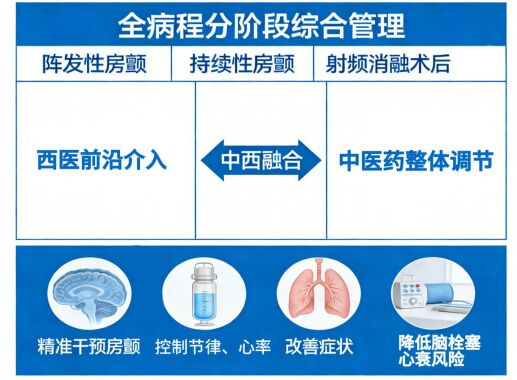
Mr. Jin, 64 years old from Henan, has suffered for more than ten years from palpitations and sweating. Whenever exposed to cold or overexertion, his palpitations and sweating worsen, accompanied by coughing and expectoration of white phlegm. After hospital examination, he was diagnosed with paroxysmal atrial fibrillation and atrial premature beats. Three years ago, he underwent radiofrequency ablation, which initially improved symptoms, but they recurred one and a half years later. Despite adhering to standard medication, his palpitations were not effectively controlled. Seeking TCM treatment, he came to Hebei Yiling Hospital. A 24-hour Holter ECG showed over 9,400 atrial premature beats and 439 atrial tachycardia episodes, along with bigeminy and trigeminy. Professor Jia Zhenhua, Director of Hebei Yiling Hospital, carefully examined and diagnosed him with arrhythmia attributed to Qi and Yin deficiency. Accordingly, he prescribed a Chinese herbal decoction to tonify Qi and Yin and activate blood and unblock collaterals. After about one month of medication, Mr. Jin’s palpitations significantly eased, sweating almost disappeared, and a repeat 24-hour Holter ECG showed atrial premature beats reduced to 492, with atrial tachycardia, bigeminy, and trigeminy nearly eliminated. Professor Jia stated that anti-arrhythmic Chinese medicine guided by collateral theory has a dual effect on fast and slow arrhythmias and integrated regulation, playing a remarkable role especially in treating refractory arrhythmias.
3. After Stent Placement, Heart Condition Relapsed; Tongluo Treatment Nearly Eliminated Symptoms in Over a Month
Mr. Zhang, who underwent stent implantation, had been taking oral medication for routine treatment. However, clinical symptoms such as chest pain and chest tightness reappeared shortly after the procedure. Mr. Zhang actively cooperated with doctors for treatment, but the therapeutic effect was not ideal. Under these circumstances, he chose to receive Traditional Chinese Medicine (TCM) treatment. After carefully understanding the changes in Mr. Zhang’s condition and conducting a comprehensive examination, Academician Wu Yiling formulated a treatment plan. Following more than a month of TCM collateral therapy focusing on tonifying qi and nourishing yin, resolving blood stasis and unblocking collaterals, promoting blood circulation and diuresis, Mr. Zhang’s follow-up examination showed that he basically had no obvious discomfort, with chest tightness, pain, and shortness of breath largely resolved. Research indicates that in patients with acute myocardial infarction, adding collateral-unblocking herbs to conventional Western medication and stent treatment can significantly reduce the incidence of myocardial no-reflow after stent implantation, improve myocardial microcirculation perfusion, protect the myocardium, reduce ventricular remodeling, and prevent progression to chronic heart failure. This improves the long-term prognosis of patients with myocardial infarction who have undergone stent implantation. Patients with coronary heart disease after stent implantation may, under physician guidance and according to their specific condition, use the collateral-unblocking TCM formula “Tongxin” to help address microcirculatory disorders and myocardial protection challenges, thereby improving clinical symptoms, enhancing quality of life, and achieving both symptomatic relief and root cause treatment.
Cardiovascular Department, Hebei Yiling Hospital, National Regional Diagnosis and Treatment Center
The Cardiovascular Department of Hebei Yiling Hospital is a key clinical specialty of Traditional Chinese Medicine (TCM) designated by the National Health Commission, the only national key clinical specialty of TCM cardiovascular disease in Hebei Province, a National Regional Diagnosis and Treatment Center, a key research laboratory and key discipline construction unit for collateral disease under the National Administration of Traditional Chinese Medicine, and a cardiovascular diagnosis and treatment base affiliated with Beijing Fuwai Hospital. Founded by Professor Wu Yiling, Academician of the Chinese Academy of Engineering and a renowned domestic TCM cardiovascular expert, it is a pillar department integrating clinical care, scientific research, and teaching, featuring integrated Chinese-Western medicine diagnosis and treatment.
Guided by the TCM theory of collaterals and meridians, the Cardiovascular Department systematically studies the pathogenesis of coronary heart disease, arrhythmia, and chronic heart failure, formulating treatment methods and effective prescriptions from a novel perspective. Relying on specially developed collateral-unblocking medicines, it has established a systematic collateral-unblocking treatment protocol for cardiovascular diseases, forming a distinctive integrated Chinese-Western medicine approach to vascular disease treatment. The treatment methods and collateral-unblocking medicines created by this department can significantly stabilize vulnerable plaques and reduce cardiovascular event incidence in coronary heart disease treatment, improving the long-term prognosis of patients undergoing acute myocardial infarction intervention. In arrhythmia treatment, they effectively manage premature beats and atrial fibrillation, and significantly increase heart rate in patients with bradyarrhythmia, providing medication options for patients with bradyarrhythmia accompanied by premature beats and those with heart failure complicated by arrhythmia. The collateral-unblocking medicines developed for chronic heart failure improve both clinical symptoms and prognosis. These achievements demonstrate the department’s unique advantages in treating major cardiovascular diseases.
Strong Alliance Establishes Cardiovascular Diagnosis and Treatment Base
In November 2011, Beijing Fuwai Cardiovascular Hospital, a nationally authoritative hospital in the cardiovascular field, and Hebei Yiling Hospital, known for innovation in collateral disease theory, officially signed a strategic cooperation agreement. Cardiovascular experts from Beijing Fuwai Hospital regularly consult at Hebei Yiling Hospital, jointly conducting integrated Chinese-Western medicine diagnosis and treatment of cardiovascular diseases. Meanwhile, Beijing Fuwai Hospital has dispatched top domestic experts in coronary intervention, arrhythmia radiofrequency ablation, and pacemaker implantation to Hebei Yiling Hospital to perform interventional procedures regularly. This marks the integration of resources and a strong alliance dedicated to cardiovascular disease research, significantly enhancing the clinical treatment level of integrated Chinese-Western medicine for cardiovascular diseases.
Consultation and Appointment: 0311-83824292