In today’s era of rapid medical technological advancement, robots, as advanced minimally invasive surgical devices and operational tools, are gradually becoming indispensable and powerful “assistants” for surgeons. Recently, with close collaboration between the Department of Neurosurgery, Radiology, and the Operating Room at Hebei Yiling Hospital, the hospital successfully performed its first in-house robot-navigated brain tumor biopsy, promptly and accurately confirming the pathology and providing direction for the patient’s subsequent comprehensive treatment.
Case Review:
It is reported that Ms. Wang had been suffering from intermittent headaches frequently over the past two weeks and developed left-sided limb weakness one day prior. Seeking further treatment, she came to the Department of Neurosurgery at Hebei Yiling Hospital. The attending physician, considering her symptoms and CT report, arranged a DWI scan, which revealed a space-occupying lesion in the right temporal lobe. Subsequent contrast-enhanced MRI further suggested a possible high-grade glioma. In neurosurgery, routine imaging alone often cannot precisely determine tumor nature, which directly dictates the patient’s later treatment plan and is critical to the entire therapeutic process. Therefore, to provide a basis for subsequent treatment, biopsy surgery became the primary task.
Surgical Robot “Assists” Brain Tumor Biopsy
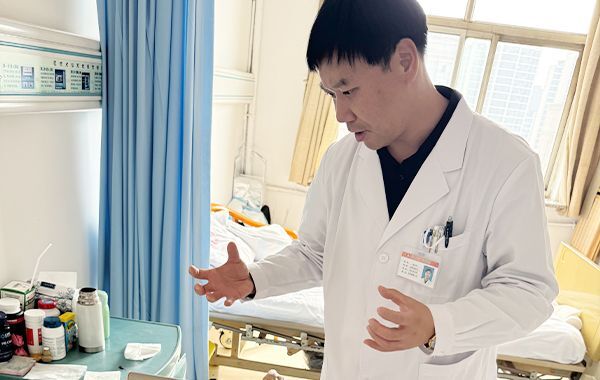
Zhang Zhimin, Chief Physician of Neurosurgery at Hebei Yiling Hospital, pointed out that the brain, as the central organ of the human body, has a delicate and complex structure with multiple important functional areas and blood vessels distributed throughout the brain tissue. Brain tumor biopsy is highly challenging; doctors must integrate the patient’s MRI and CT imaging data, use clinical experience to distinguish tumor from edema, precisely locate the tumor, and carefully avoid blood vessels to ensure tumor tissue is obtained with minimal damage to brain tissue. Any slight error could result in the patient failing to regain consciousness or suffering severe loss of hand or foot function. The surgical risks are self-evident. With robotic assistance for brain tumor puncture biopsy, only a bone hole of about 5mm needs to be drilled, allowing precise puncture site localization with minimal error, shorter operation time, and safe avoidance of critical vessels and functional areas. This minimally invasive approach reaches the lesion site to obtain pathological tissue with clear advantages. After repeated analysis and discussion, the neurosurgical team decided to employ the “robot” to assist this surgery.
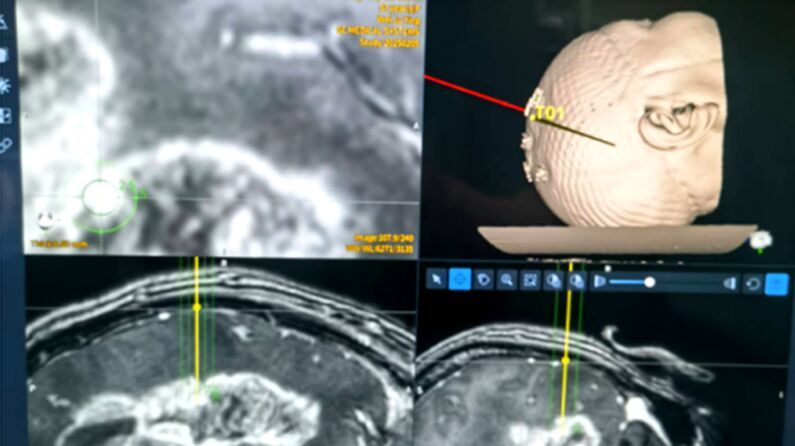
After full communication with the patient’s family and obtaining consent, the neurosurgical team developed a surgical robot-navigated puncture biopsy plan. Combining preoperative imaging data, they precisely located the lesion, marked the patient’s scalp to plan the surgical site and trajectory. Intraoperatively, through the operative port and under robotic assistance, a stereotactic puncture was performed directly to the lesion site, assisting the surgeon in completing the biopsy and removing part of the diseased brain tissue. The surgery proceeded smoothly as planned, with precision and minimal invasiveness, maximally protecting surrounding normal brain tissue and providing a reliable diagnostic basis for the patient’s further treatment.
Neurosurgical “Robot” Navigation and Positioning System
Since introducing the surgical robot navigation and positioning system, the Department of Neurosurgery at Hebei Yiling Hospital has widely applied it clinically, facilitating navigation for brain tumors, intracerebral hemorrhage, brain tumor resections, trigeminal neuralgia balloon compression, hematoma aspiration, intracranial electrode implantation, and other treatments. This has improved surgical accuracy and reduced patient complications.
The successful implementation of this neurosurgical robot-assisted brain tumor biopsy marks a significant leap in the hospital’s advanced surgical technology. It highlights the hospital’s proactive exploration and strong capability in introducing and applying cutting-edge medical technology, securing more technical advantages for the Department of Neurosurgery in treating complex diseases, vigorously promoting the discipline’s advancement to a higher level, and enhancing the hospital’s competitiveness and influence within the regional and provincial medical industry.
(Excerpted from Hebei News Network, 14 February 2025)