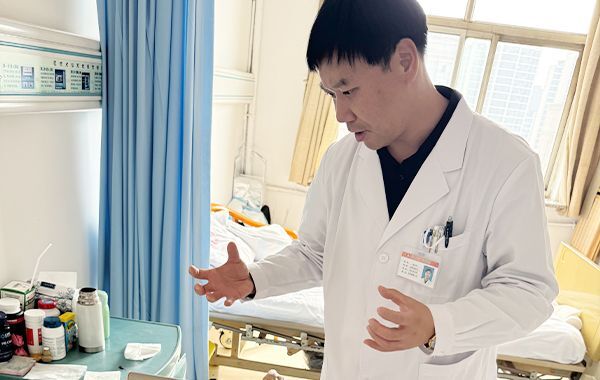
On December 28th, the Academic Forum on Integrated Chinese and Western Medicine for the Diagnosis and Treatment of Digestive Diseases and the Academic Experience Exchange Meeting of Professor Liu Zengxiang, a Renowned TCM Physician of Hebei Province, were held at Hebei Yiling Hospital. The meeting was chaired by Ping Yang, Deputy Director of the Yiling Health Management Center, and opened with a speech by Gao Huailin, Executive Vice President of Hebei Yiling Hospital. Renowned digestive disease experts including Professor Liu Zengxiang, a famous TCM physician of Hebei Province, Professor Liu Jianping from Hebei Provincial Hospital of Traditional Chinese Medicine, Professor Feng Zhijie from the Second Hospital of Hebei Medical University, Chief Physician Yan Xiaohong and Doctor Yang Zejiang from Hebei Yiling Hospital delivered excellent academic presentations sharing their clinical experiences.
At this forum, several provincial experts gave academic lectures on topics such as the construction of the TCM syndrome differentiation and treatment system for digestive diseases based on the “One Soothing, Two Regulation, Three Differentiation” approach, the distinctive integrated Chinese and Western medicine diagnosis and treatment of common digestive diseases, and the application of endoscopy. They engaged in enthusiastic academic exchanges and discussions with clinicians at the forefront of digestive disease diagnosis and treatment, actively expanding clinical physicians’ diagnostic and therapeutic thinking, greatly promoting the improvement of integrated Chinese and Western medicine clinical diagnosis and treatment of digestive diseases.
As the organizer of this academic forum, Hebei Yiling Hospital has always adhered to the characteristic integrated Chinese and Western medicine diagnosis and treatment. The hospital’s Digestive Disease Department is a provincial key TCM specialty in Hebei Province. For many years, it has been dedicated to the integrated diagnosis and treatment of digestive system diseases, persistently combining the respective diagnostic and therapeutic advantages of TCM and Western medicine to continuously improve treatment outcomes and maximize patient benefits. The Digestive Disease Department at Hebei Yiling Hospital inherits and innovates the TCM collateral-disease theory and pulse vessel theory, applying the unique “One Soothing, Two Regulation, Three Differentiation” digestive disease diagnosis and treatment system created by Professor Liu Zengxiang, a renowned TCM physician of Hebei Province. This has established a distinctive TCM treatment advantage, clinically applied to refractory digestive diseases such as chronic atrophic gastritis with intestinal metaplasia, effectively relieving symptoms while controlling or even reversing disease progression, truly achieving “treating existing diseases and preventing diseases before onset.”
Meanwhile, the Digestive Disease Department at Hebei Yiling Hospital continuously explores and develops, aligning with cutting-edge medical technology, especially excelling in digestive endoscopic examination and treatment. Currently, the department is proficient in performing gastroscopy, colonoscopy, painless gastroscopy and colonoscopy, painless duodenoscopy; endoscopic mucosal resection (EMR); endoscopic submucosal dissection (ESD) for early mucosal cancer and submucosal tumors; endoscopic lithotripsy for gastric bezoars; endoscopic foreign body removal; various endoscopic hemostasis procedures for gastrointestinal bleeding; esophageal variceal ligation; gastric variceal tissue glue and sclerotherapy injections; endoscopic dilation for gastrointestinal strictures; endoscopic stent placement (including esophageal, cardia, pyloric, biliary, and colorectal stents); endoscopic foam sclerotherapy for internal hemorrhoids; endoscopic retrograde cholangiopancreatography (ERCP); endoscopic retrograde appendicitis therapy (ERAT); and E-MAX minimally invasive endoscopic treatments. These new technologies offer advantages such as curing diseases and preserving organs and functions, providing treatment opportunities for more complex cases or elderly patients. Hebei Yiling Hospital’s Digestive Disease Department combines the advantages of endoscopic diagnostic and therapeutic techniques with innovative TCM syndrome differentiation treatment systems, establishing a distinctive “standardized diagnosis + endoscopic intervention + integrated Chinese and Western treatment” triadic diagnosis and treatment model, more effectively and comprehensively safeguarding digestive health.
Innovating the Digestive Disease Diagnosis and Treatment System: Establishing a “Triadic” Clinical Holistic Thinking Model
The “One Soothing, Two Regulation, Three Differentiation” digestive disease diagnosis and treatment system was summarised by Professor Liu Zengxiang, a renowned TCM physician of Hebei Province and Vice President of the Hebei Provincial Association of Traditional Chinese Medicine, based on years of clinical practice experience, further refining the theoretical system of TCM treatment for digestive diseases. This system integrates theoretical, clinical, and research advantages, advocates simultaneous treatment of liver and spleen, and is clinically applied to functional gastrointestinal disorders, acute and chronic gastritis, intestinal metaplasia, peptic ulcers, and hepatobiliary diseases, achieving remarkable therapeutic effects.
In the “One Soothing, Two Regulation, Three Differentiation” system, “One Soothing” refers to the emphasis on soothing the liver and stomach during treatment. Professor Liu Zengxiang explains that a considerable portion of digestive diseases, such as functional gastrointestinal disorders, chronic gastritis, and peptic ulcers, are often related to emotional changes and emotional disorders. TCM theory places significant importance on the liver’s influence on the spleen; therefore, Professor Liu particularly emphasizes soothing the liver and regulating qi to harmonize the stomach during treatment. Based on the patient’s specific condition, he combines this with methods to strengthen the spleen, warm the middle burner, descend rebellious qi, and assist transportation. Correspondingly, the use of Western medicine alone can more effectively improve symptoms. “Two Regulation” means that while regulating the spleen and stomach, other related organs should also be treated according to syndrome differentiation. TCM theory holds that the organs influence each other, with the heart, lungs, and kidneys closely related to the spleen and stomach. Therefore, Professor Liu’s treatment is not limited to the spleen and stomach but also adjusts the heart, promotes lung function, and tonifies the kidneys according to the specific condition to assist qi and blood metabolism, nourish the spleen and stomach, and focus on the whole body to improve treatment outcomes. “Three Differentiation” refers to the combined differentiation of disease type, syndrome, and disease trend. Professor Liu believes that “Three Differentiation” are three essential steps in disease treatment. First, differentiate the disease type to establish a clear diagnosis; second, differentiate the syndrome to leverage TCM syndrome differentiation advantages, clearly identifying the disease mechanism based on specific symptoms, disease progression stage, and patient constitution, distinguishing cold, heat, deficiency, and excess to provide targeted treatment; third, differentiate the disease trend to clarify disease progression and prognosis accurately, guiding medication and treatment to maintain a balanced overall approach without bias.
Combining Prevention and Treatment: Targeting Disease Mechanisms to Regulate and Treat Digestive Diseases
Applying the “One Soothing, Two Regulation, Three Differentiation” characteristic TCM diagnosis and treatment system for digestive diseases allows for holistic syndrome differentiation, rational treatment, and integration of treatment and nourishment, achieving “treating existing diseases and preventing diseases before onset.” This approach effectively eliminates causes and consolidates efficacy for refractory or easily recurrent digestive diseases.
Chronic gastritis is a common clinical digestive disease that tends to recur due to poor dietary habits and other factors. Chronic inflammation stimulates the gastric mucosa, which over time may lead to structural and functional changes, resulting in atrophic gastritis and even intestinal metaplasia. These are precancerous gastric lesions with serious health implications, requiring high attention and intervention. Under the guidance of the “One Soothing, Two Regulation, Three Differentiation” digestive disease diagnosis and treatment system, the Digestive Disease Department at Hebei Yiling Hospital focuses clinical research on TCM treatment of atrophic gastritis. Based on the fundamental pathogenesis of liver-spleen disharmony and pathogenic obstruction of the middle burner, combined with clinical symptoms, the treatment principle is to soothe the liver, harmonize the stomach, and strengthen the spleen, with formula adjustments to support the healthy qi, eliminate pathogens, soften hardness, disperse masses, and protect the gastric mucosa.
Professor Liu Zengxiang has summarised an empirical formula through extensive clinical practice for treating atrophic gastritis. This treatment not only significantly improves disease symptoms but also, in several cases, endoscopic and pathological examinations have shown repair of damaged gastric mucosa and reversal of intestinal metaplasia. Thus, through effective TCM syndrome differentiation, it prevents precancerous lesions and halts further disease progression, achieving “prevention before disease onset.”
Additionally, for common and frequently occurring digestive diseases such as functional gastrointestinal disorders and peptic ulcers, under Professor Liu Zengxiang’s guidance, the Digestive Disease Department at Hebei Yiling Hospital often starts from pathogenesis such as liver-stomach disharmony and liver-spleen disharmony, treating with methods to soothe the liver, regulate qi, harmonize the stomach, strengthen the spleen, and support the middle burner. These treatments effectively relieve digestive discomfort symptoms and reduce recurrence, achieving favourable clinical outcomes.
The department leverages its TCM characteristic diagnostic and therapeutic advantages, organically combining them with advanced technologies such as minimally invasive endoscopy. It has achieved remarkable efficacy in the clinical diagnosis and treatment of common and refractory digestive system diseases, earning widespread patient acclaim. Hebei Yiling Hospital will take this academic forum as an opportunity to continuously innovate and develop, enhance the department’s integrated Chinese and Western medicine specialty advantages, and provide patients with more comprehensive and high-quality services.
— Excerpted from Hebei News Network, December 30, 2024