In the field of spinal surgery, thoracic spinal stenosis has long been regarded as a “surgical no-go zone.” Due to its unique anatomical structure and the fragility of the thoracic spinal cord, traditional open surgery carries extremely high risks, where even slight carelessness can lead to catastrophic paralysis. However, the Second Orthopaedics and Traumatology Ward at Hebei Yiling Hospital has successfully overcome this “binding spell” using minimally invasive spinal endoscopy technology through a mere 7 mm incision, offering a brand-new treatment option for patients with thoracic spine diseases.
It is reported that Ms. Wang, aged 43, had her previously peaceful life completely disrupted by a sudden health crisis four months ago. Initially, she only experienced mild weakness in both lower limbs and some difficulty walking. “Maybe I was just overworked,” she comforted herself, but as time went on, her symptoms not only failed to improve but worsened. Her legs felt as heavy as lead, and she eventually became unable to walk.
“During that period, even the simplest walk became a luxury,” Ms. Wang recalled. “The scariest part was not knowing what was wrong with me.” At a local hospital, doctors offered various possible diagnoses: lumbar disc herniation, neuritis, and even psychosomatic symptoms caused by psychological factors. She tried multiple conservative treatments including medication and physiotherapy, but the effects were minimal. Her quality of life sharply declined, and the once cheerful woman became depressed and even lost faith in treatment.
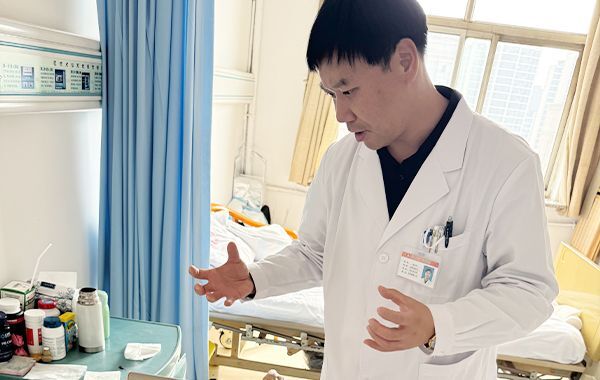
Just as Ms. Wang was about to give up, a friend recommended Chief Physician Gao Junmao from the Second Orthopaedics and Traumatology Ward at Hebei Yiling Hospital. “At that time, I had almost no hope left, but my family insisted I try once more,” Ms. Wang said.
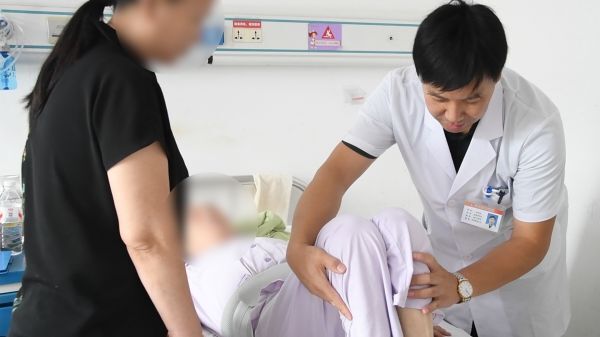
After Chief Physician Gao Junmao received Ms. Wang, he conducted a detailed physical examination and, relying on his extensive clinical experience, keenly sensed that her symptoms were not simply related to lumbar spine issues. Based on her symptoms and signs, he considered thoracic spinal stenosis to be a more likely diagnosis. To further clarify, Chief Gao arranged for Ms. Wang to undergo CT, MRI, and other relevant imaging studies, ultimately confirming thoracic spinal stenosis with significant spinal cord compression.
Chief Physician Gao Junmao explained that thoracic spinal stenosis is a syndrome caused by a reduced cross-sectional area of the thoracic spinal canal leading to compression of the thoracic spinal cord. It is currently a challenging issue in spinal surgery. Main symptoms include lower limb pain, numbness, weakness, sensory disturbances, intermittent claudication, bowel and bladder dysfunction, sphincter dysfunction, and a band-like sensation in the chest, abdomen, or lower limbs. A minority of cases may present with intercostal neuralgia, lumbar and leg pain, and various manifestations of thoracic spinal cord injury. Severe spinal cord damage caused by this condition can seriously impair patients’ quality of life and may even result in paraplegia.
Faced with Ms. Wang’s condition, Chief Gao and his team believed that although traditional open surgery could resolve the problem, it involved large trauma, significant blood loss, and required spinal fixation with pedicle screw-rod systems, resulting in long recovery times and higher postoperative complication risks. Considering Ms. Wang’s relatively young age, Chief Gao and his team promptly conducted a thorough study and in-depth case discussion of her condition. After repeated evaluation and deliberation, they ultimately developed a minimally invasive surgical plan: “unilateral laminotomy with bilateral spinal canal decompression under spinal endoscopy for the thoracic spine.”
“This surgery only requires a small incision of about 7 millimetres on the back. Using a transforaminal endoscope, we can precisely relieve the spinal cord compression while maximally preserving the surrounding normal tissues. Compared with traditional surgery, this minimally invasive technique offers significant advantages such as less trauma, reduced bleeding, and faster recovery,” Chief Gao explained the surgical plan to Ms. Wang in detail.
After thorough preoperative communication, Ms. Wang and her family gladly accepted this treatment plan. “Chief Gao’s explanation gave me great confidence in the surgery. Most importantly, I finally saw hope for recovery,” Ms. Wang said.
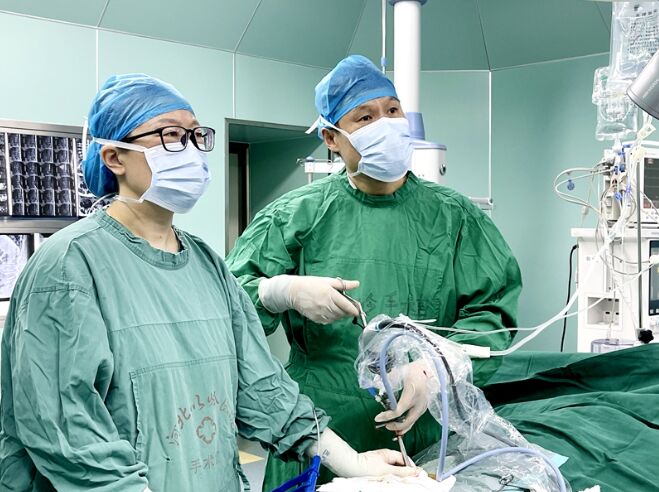
With everything prepared, Chief Gao personally performed the surgery. Assisted by precise spinal endoscopy, the surgical team used the tiny incision to accurately remove the ossified ligamentum flavum compressing the spinal cord. At the end of the operation, Ms. Wang immediately felt much relief in her legs; the heavy sensation that had bound her lower limbs seemed to vanish instantly, and her numbness was significantly alleviated. She was able to get out of bed and move on the second day after surgery, and by discharge, Ms. Wang could walk independently again, regaining her confidence and courage in life.
Chief Physician Gao Junmao stated that Hebei Yiling Hospital’s Orthopaedics and Traumatology Department has successfully performed numerous fully endoscopic spinal surgeries. The team has mastered the current mainstream minimally invasive spinal endoscopy techniques and accumulated rich clinical experience, benefiting a wide range of spinal disease patients with minimal trauma, extremely high safety, and excellent surgical outcomes. This department’s superb medical skills, advanced concepts, and highly responsible attitude toward patients enabled the successful use of minimally invasive technology to relieve Ms. Wang’s suffering. This not only demonstrates the hospital’s leading level in spinal disease treatment but also brings good news to many patients with thoracic spinal stenosis. Chief Gao also reminds the public that if they experience unexplained lower limb weakness or difficulty walking, they should seek medical attention promptly for comprehensive examinations to rule out thoracic spinal stenosis and other diseases.
— Excerpted from Hebei News Network, 1 April 2025