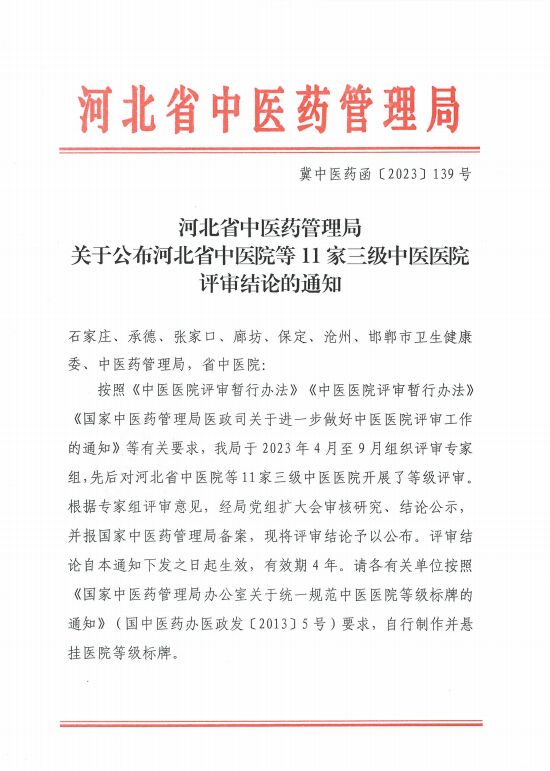
News Report: Recently, to further promote the inheritance, innovation, and development of traditional Chinese medicine (TCM), strengthen the construction of TCM specialties, and improve the level of TCM medical technology, the Shijiazhuang Municipal Health Commission conducted an evaluation of key TCM specialties in Shijiazhuang. In this evaluation, after multiple rounds of expert screening, strict review, and industry-wide public announcement by the Municipal Health Commission, four specialties at Hebei Yiling Hospital—Pulmonology, Nephrology, Spleen and Stomach Diseases, and Oncology—were awarded key specialty status. Among them, Pulmonology, Nephrology, and Spleen and Stomach Diseases were approved as key TCM specialties of Shijiazhuang City, while Oncology was recognized as a key TCM specialty construction unit of Shijiazhuang City. With this, Hebei Yiling Hospital now has 10 key specialties at the national, provincial, and municipal levels; 1 national regional TCM diagnosis and treatment centre; including 1 national key clinical TCM specialty; 2 key specialties designated by the National Administration of Traditional Chinese Medicine; 3 key specialty construction units designated by the Hebei Provincial Administration of Traditional Chinese Medicine; 3 key TCM specialties of Shijiazhuang City; and 1 key TCM specialty construction unit of Shijiazhuang City.
Since its establishment 30 years ago, Hebei Yiling Hospital has consistently adhered to the hospital policy of integrating Chinese and Western medicine, inheriting and innovating the TCM collateral-disease theory and pulse vessel theory, driving the development of departmental specialties and the hospital’s growth. It has formed a collateral-disease syndrome differentiation and treatment system guided by TCM for various refractory diseases. Through years of clinical research, the hospital has developed over one hundred effective characteristic Chinese herbal preparations, achieving the principle of “specific medicine for specific diseases, expertise for specific medicines.” This has led to the formation of a number of clinical departments with distinctive integrated Chinese-Western medicine features. The hospital combines specialty construction with discipline development, vigorously strengthens infrastructure, continuously improves medical and nursing services, enhances internal quality, focuses on improving management levels, and continuously leverages the unique advantages of TCM. It has developed into a comprehensive tertiary Grade A hospital with distinctive integrated Chinese-Western medicine characteristics, encompassing medical treatment, teaching, research, prevention, and health care. A relevant hospital official stated that the increasing number of approved key specialties and specialty units results from comprehensive improvements in the hospital’s overall diagnostic and treatment capabilities, talent team building, and academic research, reflecting the hospital’s comprehensive strength and the distinctive advantages of its TCM specialties.
Among these, the Pulmonology Department at Hebei Yiling Hospital applies the collateral-disease theoretical framework to establish the lung collateral theory, exploring the pathogenesis characteristics of externally contracted warm diseases and epidemic pestilences. It has developed the Lianhua series of Chinese herbal preparations and standardized prescriptions. Targeting characteristic diseases such as asthma (chronic obstructive pulmonary disease), cough (chronic cough), wind-warm lung-heat disease (community-acquired pneumonia), wheezing disease (bronchial asthma), influenza, and pulmonary vascular diseases, the department has formulated advantageous disease-specific diagnosis and treatment protocols and implemented multiple characteristic TCM therapies. Meanwhile, the department follows Western medical diagnostic and treatment standards, possessing rich experience in treating various chronic respiratory diseases and respiratory critical illnesses. It is proficient in invasive and non-invasive ventilator use, bronchoscopy and interventional therapy, and lung nodule ablation treatment, providing patients with appropriate integrated Chinese-Western medical diagnostic and treatment options.
The Nephrology Department vigorously develops characteristic TCM therapies. Guided by the TCM collateral-disease theory and combined with the theory of water diseases and their transmission patterns, it treats kidney diseases by simultaneously addressing “Qi, blood, and water,” cooperating with Western medicine to repair the glomerular filtration membrane and reduce renal atrophy. It has demonstrated significant advantages in the clinical treatment of difficult kidney diseases such as refractory proteinuria, renal failure, and haematuria. The department has also formulated diagnosis and treatment protocols and standardized prescriptions for three key diseases: chronic renal failure, diabetic nephropathy, and oedema, effectively improving treatment outcomes.
The Spleen and Stomach Diseases Department fully utilises the advantages of integrated Chinese-Western medicine treatment, with outstanding capabilities in endoscopic examination and treatment, including ERCP, NOTES gallbladder-preserving lithotomy, ERAT for appendicitis, endoscopic mucosal resection, early gastrointestinal cancer screening, and endoscopic treatment of oesophageal and gastric varices and gastrointestinal bleeding. Simultaneously, the department continuously refines the TCM theoretical system for treating spleen and stomach diseases, advocating simultaneous treatment of liver and spleen. Based on the close relationship among the liver, spleen, and stomach and years of clinical experience, it has developed a characteristic diagnosis and treatment model for spleen and stomach diseases integrating theoretical, clinical, and research advantages, termed “One Smoothing, Two Regulation, Three Differentiation.” It has established characteristic treatment protocols for key diseases such as epigastric pain (chronic gastritis), chronic diarrhoea (ulcerative colitis), and abdominal distension (cirrhotic ascites). Combined with various characteristic therapies including Chinese herbal compresses, hot poultices, thunder-fire moxibustion, Chinese herbal plasters, and medium-frequency pulsed electrotherapy, the department has significantly enhanced treatment efficacy.
The Oncology Department adheres to the essence of traditional Chinese medicine, combined with modern medicine’s precise diagnostic equipment and treatment technologies. It brings together a team of oncology experts and, under the guidance of collateral-disease theory, emphasises the advantages of TCM syndrome differentiation and disease differentiation. The department innovates diagnosis and treatment by applying the integrated Chinese-Western medicine eight-character strategy of “comprehensive, collaborative, targeted, minimally invasive,” and the five-in-one model of “collateral-unblocking anti-cancer Chinese medicine + tumour intervention + immunotherapy + personalised treatment + psychological counselling.” This approach treats various malignant tumours with minimal trauma, fewer complications, and lower side effects. For patients who are inoperable, have postoperative metastasis, or are insensitive to radiotherapy and chemotherapy, the department has pioneered a distinctive integrated Chinese-Western medicine oncology treatment pathway.
The awarding of key specialty status to these four departments not only recognises Hebei Yiling Hospital’s clinical medical diagnostic and treatment level by health authorities but also reflects public trust in the hospital’s distinctive advantages in TCM specialty diagnosis and treatment. Hebei Yiling Hospital will take this opportunity to further strengthen clinical specialty and talent team building, promote academic research, continuously enhance the hospital’s comprehensive strength, develop specialty features, and provide the public with more comprehensive and higher-quality medical and health services.