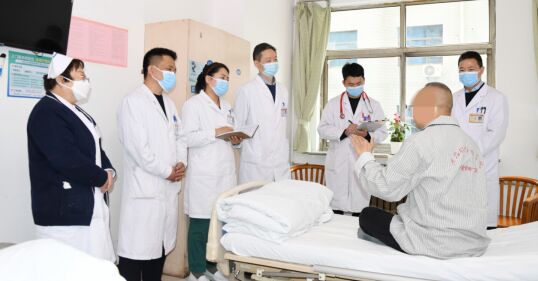
After suffering a stroke, Ms. Feng, 47, experienced limb paralysis, slurred speech, and an inability to care for herself, plunging her into despair. However, at the Rehabilitation Department of Hebei Yiling Hospital, an innovative programme combining integrated Chinese and Western medicine with brain–computer interface technology enabled her to lift her arm and take coordinated steps again in just over ten days.
Multiple Challenges: A Stroke Presses Life’s “Pause Button”
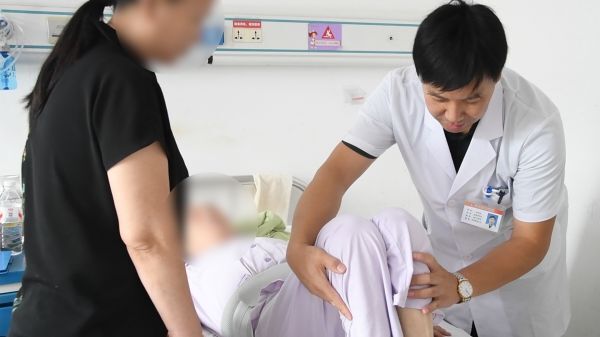
A single stroke brought Ms. Feng’s life to a complete halt at age 47. Upon admission, her left-side limb movement was severely restricted—she could not lift her left arm, nor perform even the most basic flexion and extension; she was entirely unable to make a fist with any finger. Her left leg retained only minimal strength, with an inability to bend the thigh and only slight plantar flexion of the ankle. More distressingly, her speech was unclear, she choked easily when drinking, could not sit steadily, and required full assistance to turn over or sit up. She suffered persistent pain in her left shoulder and chronic swelling in her left hand, relying entirely on family members for daily care. The combination of multiple symptoms made her rehabilitation far more challenging than typical unilateral hemiplegia.
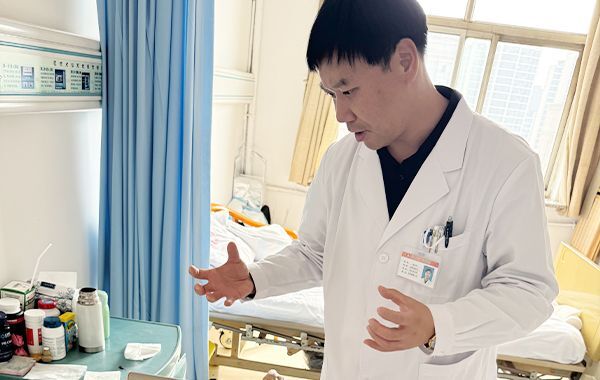
Yet, in just over ten days, she began to “rediscover” her body—her left arm could autonomously lift above her head, and her left leg started to perform controlled isolated movements. This remarkable recovery stemmed from the integrated Chinese–Western medicine plus brain–computer interface rehabilitation programme led by Chief Physician Li Hongxia of the Rehabilitation Department’s Disease Rehabilitation Ward at Hebei Yiling Hospital. As a contributor to the national group standard “Training and Evaluation of Brain–Computer Interface Adaptors” for Hebei Province, Chief Physician Li emphasises: “Rehabilitation is not about piling up equipment, but first identifying the root cause of the patient’s problems, then selecting the most suitable rehabilitation plan.”
Strengthening the Foundation: Synergistic Chinese and Western Medicine Builds a Solid Rehabilitation Base
After Ms. Feng’s stroke condition stabilised, she was admitted to Hebei Yiling Hospital’s Rehabilitation Department, the home of Hebei Province’s “Research-Oriented Brain–Computer Interface Rehabilitation Ward.” At admission, Chief Physician Li Hongxia did not rush to apply equipment but first led a multidisciplinary team to conduct a comprehensive assessment. She repeatedly stressed: “We must first optimise the patient’s overall condition and clarify the assessment before applying rehabilitation devices accurately and effectively.”
Based on the collateral-disease theory, TCM experts diagnosed Ms. Feng’s symptoms of slurred speech, shoulder pain, and hand swelling as qi deficiency, blood stasis, and internal retention of dampness. They formulated a Chinese herbal medicine regimen to tonify qi, activate blood circulation, clear collaterals, and reduce swelling, aiming to improve cerebral circulation, reduce oedema, and nourish damaged nerves. Rehabilitation physicians used internationally recognised assessment scales to precisely evaluate her motor and neurological impairments. Simultaneously, brain–computer interface adaptors collected EEG signals to determine the decodability of her motor intentions. Considering Ms. Feng’s diabetes, the team also adjusted her hypoglycaemic regimen to stabilise blood glucose levels.
Following the comprehensive evaluation, Chief Physician Li’s team devised a treatment strategy of “first regulating internally, then clearing externally,” primarily using oral Chinese medicine combined with acupuncture and electroacupuncture. Following the principle of “acupuncture to open collaterals, Chinese medicine to consolidate the root, and promoting diuresis to reduce swelling,” they first activated the meridian qi and blood and strengthened the body’s vital energy, supplemented by conventional rehabilitation training. This seemingly routine integrated rehabilitation treatment actually laid the physiological groundwork for subsequent precise brain–computer interface training. After one week, Ms. Feng’s affected limbs showed slight autonomous movement and significant reduction in hand swelling—the neural pathways between brain and limbs were not completely severed, and internal circulation and oedema had markedly improved, creating favourable conditions for brain–computer interface training.
Intention-Driven: Four Brain–Computer Interface Training Sessions Achieve a “Triple Leap”
One week later, formal brain–computer interface rehabilitation training commenced. Ms. Feng wore a lightweight EEG acquisition cap and, guided by technicians, focused her mind to imagine lifting her hand, flexing and extending her leg, and walking. The device captured motor signals from her brain in real time, rapidly decoding her intentions via AI algorithms, and synchronised upper and lower limb rehabilitation devices and an exoskeleton to assist her limbs in performing the imagined movements.
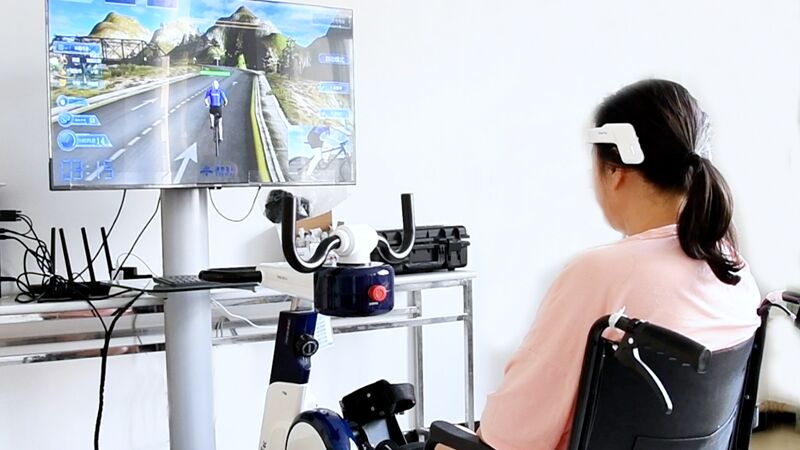
This repeated cycle of “thinking about lifting the hand, with the device moving the arm” creates a closed-loop stimulation between the brain’s central nervous system, peripheral limbs, and feedback to the brain. This method is widely used in international clinical research to activate neuroplasticity and facilitate motor function reconstruction.
Chief Physician Li Hongxia explains that throughout training, Chinese medicine and acupuncture are continuously applied: TCM nourishes brain nerves and promotes blood flow, cultivating an optimal repair environment for damaged neural pathways; the brain–computer interface precisely replicates standard movements, repeatedly stimulating and rebuilding neural connections. The combination of nourishment and training complements each other, achieving a synergistic effect greater than the sum of its parts.
The rehabilitation progress far exceeded expectations. After only four brain–computer interface training sessions, Ms. Feng’s physical condition visibly improved: her left upper limb progressed from complete immobility to autonomous lifting above her head; her left lower limb’s range of motion greatly increased, with isolated joint movements (independent movement of leg joints without stiffness or linkage), enabling coordinated actions such as ankle dorsiflexion and leg lifting; choking when drinking was significantly reduced, and her speech fluency markedly improved; shoulder pain and hand swelling were almost resolved.
In just over ten days, multiple issues including limb movement, speech, pain, and oedema improved simultaneously, achieving a three-stage leap from “immobility → autonomous movement → coordinated fine motor skills.” This is a direct outcome of integrating traditional Chinese medicine with cutting-edge brain–computer interface technology.
Standardised Safeguards: Ensuring Every Patient Experiences “Resonance”
As the clinical validation base and clinical training centre for the group standard “Training and Evaluation of Brain–Computer Interface Adaptors,” the Disease Rehabilitation Ward of Hebei Yiling Hospital’s Rehabilitation Department has established a multidisciplinary collaboration model involving physicians, nurses, technicians, and engineers. From indication control, signal acquisition, parameter optimisation to rehabilitation nursing, every step follows strict standards to ensure that every patient receives high-quality brain–computer interface rehabilitation services safely and in compliance with protocols.
Appointment and Consultation: 400-612-2156